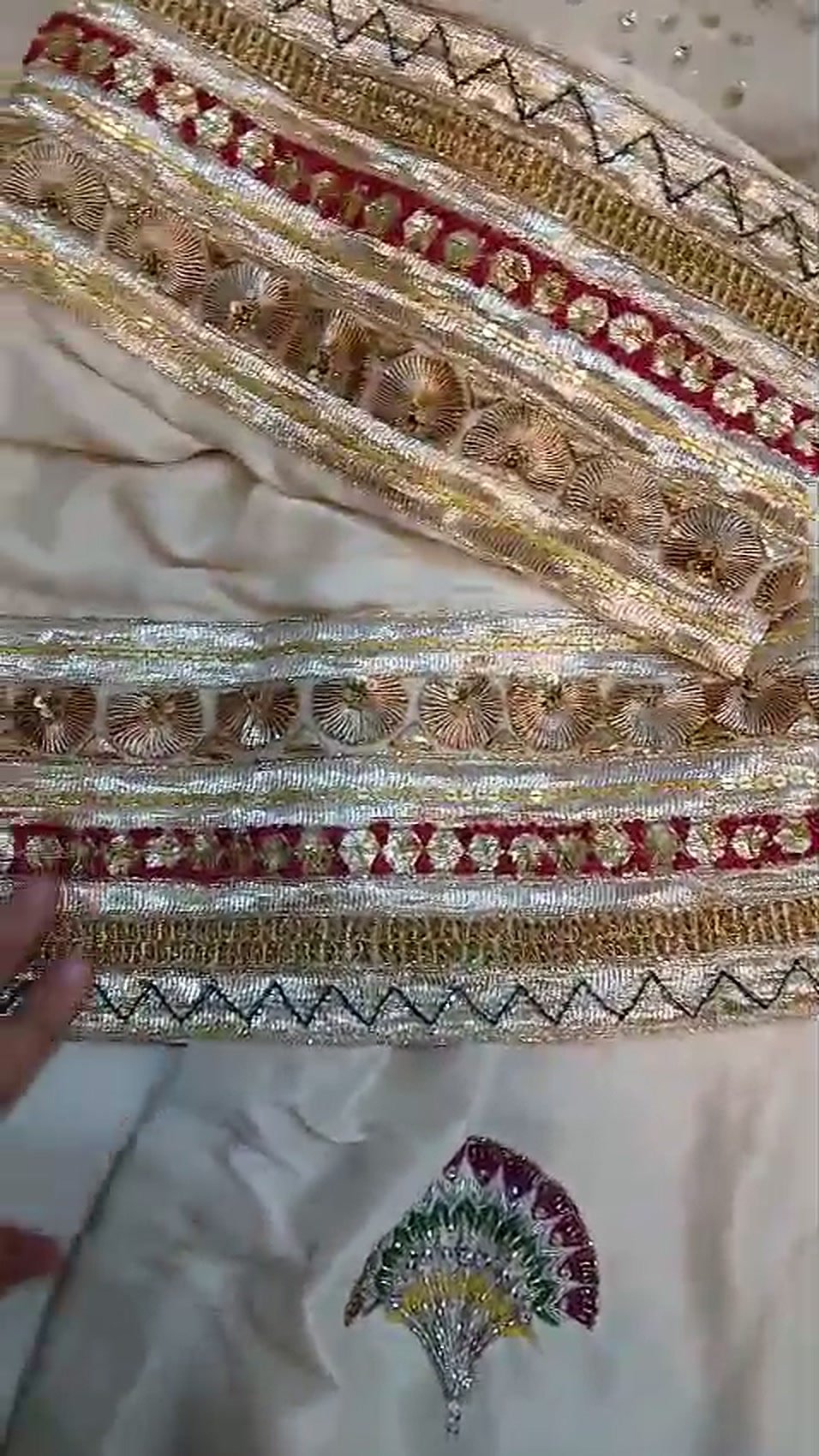
"How much is a Pakistani bridal dress?" is one of the most searched questions in the UK, USA, Canada and Australia,
and the honest answer is that there is no single number. Two red bridal lehengas that look alike in a photograph can
cost several times apart, and the difference is almost never the brand name on the label. It is the hours of
handwork, the fabric, the cut and the finishing. This guide explains what you are actually paying for, so that when a
quote arrives you can read it.
1. Handwork hours are most of the cost
A bridal piece from our workshop is about 90% handwork, and handwork is paid by the hour. A karigar (the craftsman)
sits at a wooden frame called an adda and works one motif at a time with a needle and a hook. The techniques brides
ask for by name all take different amounts of time:
- Zardozi: metal thread couched onto the fabric in raised patterns. The classic bridal work and the slowest.
- Dabka: fine coiled wire stitched down in lines and fills. Dense and heavy.
- Tilla: flat gold or silver thread embroidery. Lighter and quicker than dabka.
- Naqshi: tiny twisted-wire beads sewn one by one. Very fine, very slow.
- Kora and sitara: sequins and metal beads, often filling the ground between motifs.
- Resham: silk thread embroidery, usually for coloured motifs and mehndi pieces.
- Gota: woven ribbon appliqué, the quickest, and the mehndi favourite.
- Pearls, crystals and stones: sewn by hand, priced by how many and how fine.
A heavily worked barat lehenga can hold hundreds of hours of this. A lightly worked nikkah or mehndi piece holds a
fraction. That single difference explains most of the gap between two prices.
2. How much of the piece is covered
A lehenga with a fully worked skirt costs far more than one with a worked border and scattered motifs, because the
skirt is the largest area. The same goes for a dupatta: a fully jaal-worked dupatta is a project on its own, while a
dupatta with a worked border and corners is a fraction of the time. When a bride asks us to make a look lighter, this
is usually where the saving is: the same motifs, placed where the camera sees them, with the ground left clean.
3. The fabric
Raw silk, velvet, organza, net, chiffon, tissue and jamawar all cost differently, and bridal pieces use several. A
velvet lehenga with a tissue dupatta is more expensive in fabric than an organza set. Lining, can-can (the stiff
underskirt that gives a lehenga its flare) and the weight of the net all add up. Fabric is a real part of the cost
but rarely the biggest part.
4. The silhouette and the sewing
A lehenga with a 12-panel flare, a fitted choli with boning, and a trail takes more cutting and sewing than a straight
long shirt with trousers. A gown with structure, a pishwas with a wide circumference, or a gharara with pleated knees
all take skilled stitching time, and made to measure means a toile or fitting stage that a ready-made piece skips.
5. Finishing
The parts you do not see: the inside finish, the lining, the hooks and eyes, the dupatta edging, the way the handwork
is backed so it does not scratch. Good finishing is what makes a piece sit comfortably for an eight-hour night.
Cheap pieces save here, and the bride pays for it on the day.
6. Changes to a design
If you send us a look you love and ask for it in another colour, with a different dupatta or neckline, the change
itself does not usually add much. What changes the cost is whether the version you want has more or less handwork
than the original. Many brides make a look lighter for the walima or heavier for the barat; both move the quote.
What does not decide the cost here
Two things that do not change our quote: a designer's name, because we are not selling their piece, and the country
you live in, because every piece is made in the same workshop. Shipping and any customs charges in your country are
separate and explained with the quote. See the UK, USA,
Canada and Australia pages for how it works
from each.
Why the quote comes on WhatsApp
You will not find prices on this site, and that is deliberate. Because every piece is made to order, the price depends
on the design we agree, the fabric, and the weight of the handwork you choose. A number on a page would either be
wrong for your piece or would push you towards a standard design. Instead, you send us the look and your wedding date,
we plan the piece with you, and the quote arrives on WhatsApp for exactly what you asked for. If it is more than you
planned, we tell you where the handwork can be lightened without losing the look.
How to get a fair price for what you want
- Decide which event matters most. Most brides put the weight into the barat and keep the nikkah and mehndi lighter.
- Send a photo of the look you love and say what you want changed. See get a look made.
- Ask what is driving the quote. We will tell you plainly: the dupatta, the skirt, the stones.
- Allow the time. A piece takes 8 to 12 weeks to make. A rushed piece costs more and is finished worse.
Send us your look and your date, and we will tell you what it would take:
WhatsApp Omar Arshad Couture.