A Pakistani wedding is not one event. It is three or four nights, each with its own mood, its own colours and its own
dress code, and the invitation rarely spells any of it out. If you have been invited to one in London, Toronto,
Houston or Sydney and you are staring at your wardrobe, this guide tells you what guests actually wear to each
function, what to avoid, and what to do if you want something made for you.
First, know which function you are going to
Most invitations name the event. Each one has a different feel:
- The mehndi (or mayun / dholki). The bright, loud, dancing night before the wedding. Yellow, green, orange, pink
and mixed colours. Music, mehndi on the hands, and a lot of movement. Dress lighter and more playful here than at
any other event. - The nikkah. The marriage ceremony itself, often in the afternoon, sometimes at a mosque or at home. Softer and
more modest. Pastels, ivory, soft greens and dusty pinks. Covered shoulders and a dupatta are a good idea. - The barat. The main wedding night, hosted by the bride's family. The bride wears red or maroon and the heaviest
piece of the week. Guests dress up fully: formal outfits, jewel colours, handwork, heels. - The walima. The reception hosted by the groom's family, the night after the barat. Elegant and polished rather
than loud. Ivory, champagne, gold, silver, navy, emerald. Think evening wear.
If you are only going to one event, the barat and the walima are the formal ones. The mehndi is the fun one.
What women guests wear
Pakistani wedding guest outfits sit in three families, and any of them is correct at the barat or walima:
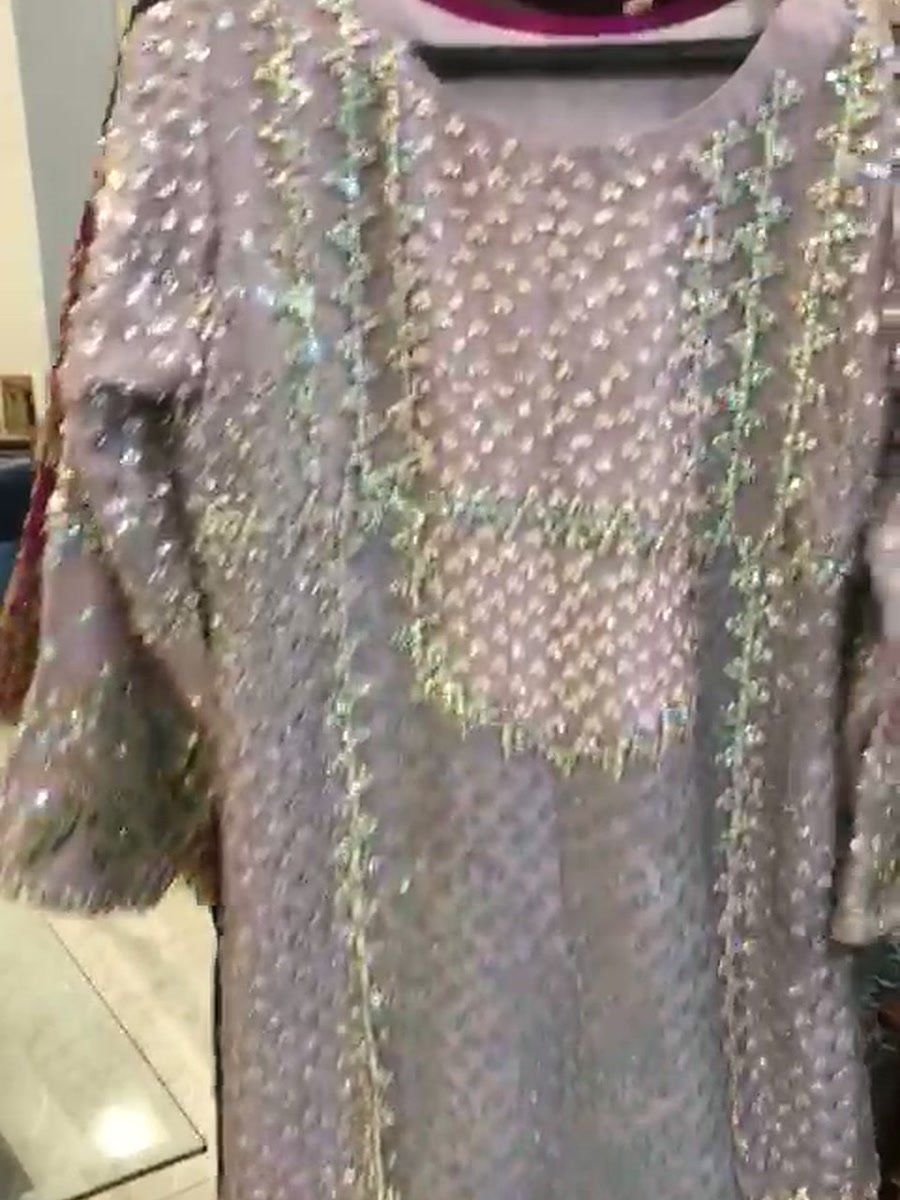
- A long shirt with trousers or a sharara. The most common guest look. A long embroidered shirt, straight
trousers (or a flared sharara), and a dupatta over one shoulder. Easy to wear, easy to sit and eat in. - A lighter lehenga. A lehenga is not only for brides. A guest lehenga is lighter, with less handwork, in a colour
that is clearly not the bride's. Popular at the barat and walima. - A gharara or sharara set. Wide, flowing trousers with a short kurti, a heritage look that has come back in a big
way. Beautiful for the mehndi in bright colours, and for the walima in pastels.
For the mehndi, go lighter: a sharara in yellow or green, a short shirt with gota work, or a cotton-silk suit you can
dance in. For the nikkah, go softer: pastel, modest, a dupatta you can put over your head if the ceremony calls for it.
Our party wear and formals pages show the kind of pieces guests
and the bride's family wear, all made to measure.
What not to wear
A few rules will keep you on the right side of every aunt in the room:
- Not red at the barat. Red and deep maroon belong to the bride on her barat. Wear any other colour.
- Not white or ivory at the walima if the bride is wearing it. Many brides choose ivory, champagne or white for the
walima. If you can, ask what she is wearing. If you cannot, choose a colour instead of white. - Not black for the whole outfit. Black is not forbidden, but an all-black outfit reads as sombre at a wedding. Black
with gold handwork, or black as one piece of a colourful outfit, is fine. - Not too revealing. Weddings are family events with grandparents present. Covered shoulders and a dupatta are
always safe. Sleeveless is fine at many weddings in the diaspora, but carry a dupatta or a shawl. - Not outshining the bride. The heaviest handwork in the room is hers. Guests wear lighter pieces.
Can you wear white to a Pakistani wedding?
This is one of the most searched questions, so here is a clear answer. White is not a bridal colour in Pakistani
tradition, so there is no rule against it for guests. But many brides now wear white, ivory or off-white at the nikkah
or walima, so at those two events it is polite to check. At the mehndi and barat, white is unusual but not wrong; an
ivory outfit with colourful gota work is a lovely mehndi look.
What a western guest can wear
If you are not South Asian and you are wondering whether you can wear Pakistani clothes: yes, and the family will be
delighted. A long embroidered shirt with trousers and a dupatta is the easiest first outfit. If you would rather stay
in western clothes, a long dress in a rich colour, with covered shoulders or a wrap, works at the barat and walima.
Avoid short dresses and anything strapless. Flat or block heels are kinder on a long night.
What men wear
Men have it simpler. A sherwani or a waistcoat over a kurta for the barat and walima; a plain kurta and shalwar for the
mehndi; a suit is fine at the walima in the diaspora. A bright kurta in yellow or green is the mehndi classic.
Colours by event, in one list
- Mehndi: yellow, mustard, green, mint, orange, pink, multicolour.
- Nikkah: ivory, off-white, pastel pink, soft green, powder blue, lilac.
- Barat: jewel colours: emerald, royal blue, deep pink, purple, teal, gold. Anything but red.
- Walima: ivory, champagne, gold, silver, navy, wine, emerald. Check whether the bride is in white.
Getting an outfit made to measure from abroad
Guest outfits in the four countries where our brides live are usually bought ready-made in a few standard sizes, or
borrowed. If you want something that fits you properly and is yours, we make guest outfits and formals to measure in
our own workshop in Pakistan, worked by hand, and ship them to the UK, USA, Canada and Australia. You choose the
colour and the weight of handwork, we make it in your size, and it takes 8 to 12 weeks. How it works
explains the steps, and our measurement guide shows what to measure at home.
If you have a wedding coming up, send us the event, your colour and your date on WhatsApp, and we will suggest the
piece: message Omar Arshad Couture on WhatsApp.