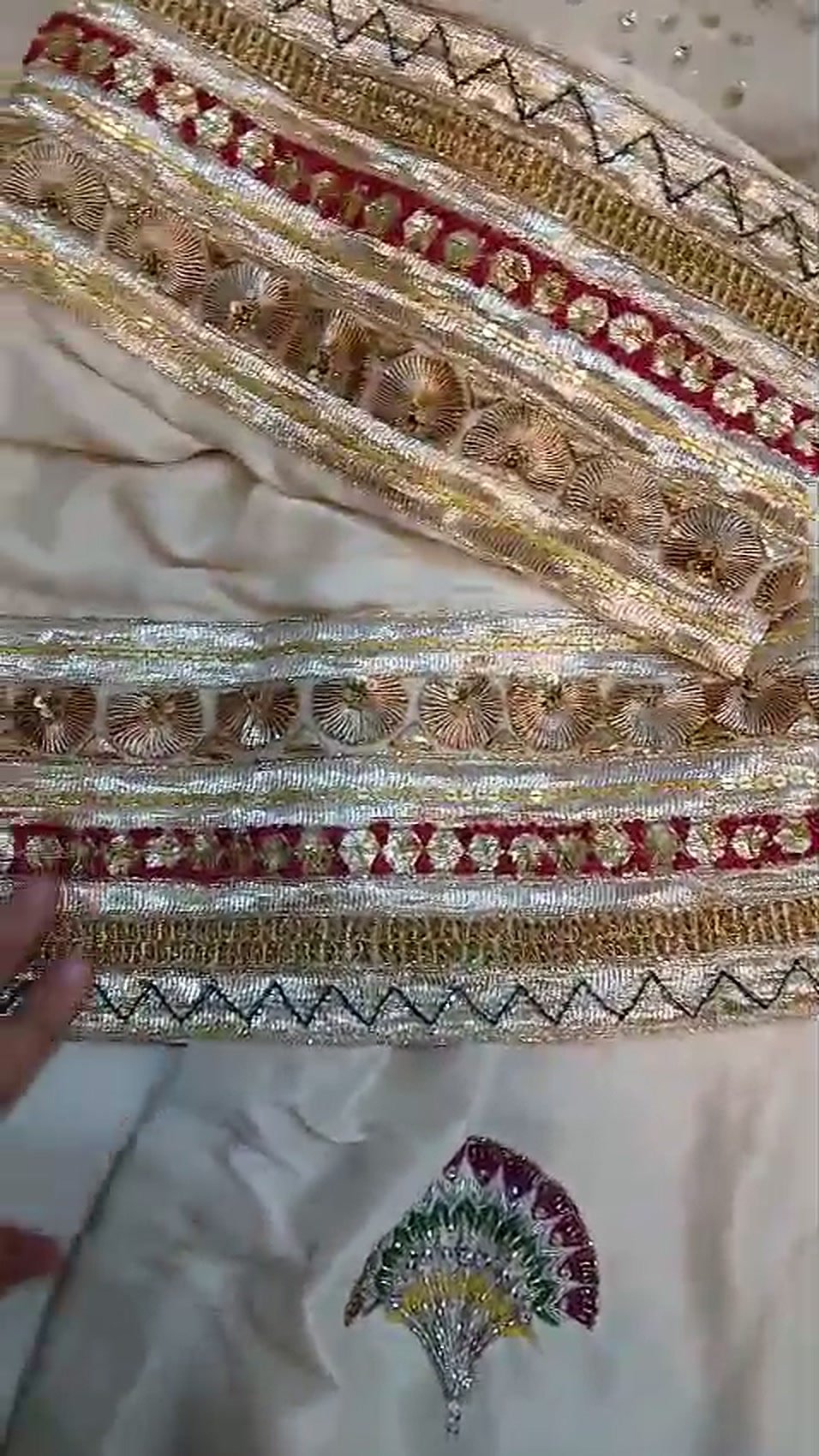
Every Pakistani bridal page uses the same words, zardozi, dabka, tilla, naqshi, kora, resham, gota, and most brides
abroad have a rough idea and not a clear one. The words matter: they tell you how a piece was made, how heavy it is,
how it will catch light and why it costs what it does. This is a plain guide to the handwork, written from a workshop
where about 90% of every bridal piece is done by hand.
How handwork is done: the adda
Nearly all of it happens on an adda: a wooden frame on which the fabric is stretched taut, with two to four karigars
(craftsmen) sitting around it. The design is traced onto the fabric with a perforated paper pattern and chalk, and
then the karigars work it with an aari (a fine hook) or a needle, one motif at a time. A heavily worked bridal
lehenga is weeks of this. When you see "hand embroidered" on a real bridal piece, this is what it means.
Zardozi
Zardozi (from the Persian for "gold sewing") is the oldest and grandest of the techniques: gold or silver metal
thread, and the metal wires that go with it, couched down onto the fabric in raised patterns, often over a padding so
the motif stands up from the cloth. Historically real gold on silk for Mughal courts; today gilt and metallic threads
on silk, velvet and net.
Zardozi is the barat's handwork: dense, three-dimensional, heavy, and it reads richly from across a hall. It is also
the slowest to make. A zardozi lehenga is the piece most brides picture when they imagine their barat.
Dabka
Dabka is a tightly coiled metal wire, like a tiny spring, cut into short lengths and stitched down to fill or outline
a motif. Lines of dabka give a motif its body; fields of dabka give it a dense, textured shimmer. Dabka is often used
inside zardozi work and alongside it, and a "dabka lehenga" is usually heavy and rich. Dull gold dabka gives the
antique look brides ask for; bright gold gives a newer, flashier finish.
Tilla
Tilla is flat metallic thread (gold, silver, copper) embroidered directly into the fabric, usually with a needle in
satin-stitch and running patterns. It lies flat rather than raised, so it is lighter than zardozi and dabka and
suits larger areas, borders and trellis (jaal) patterns. Tilla is used on barat pieces for the ground and on walima
and formal pieces as the main work.
Naqshi
Naqshi is the finest and slowest of the metal works: minute twisted-wire beads (nakshi) sewn on one by one, often
to outline petals or fill small motifs with a crisp sparkle. Naqshi is the signature of white and off-white nikkah
dresses, where it gives silver light without colour, and it is used on bridal pieces for the detail that photographs
close up.
Kora and sitara
Kora is a slightly thicker metallic bead or wire, and sitara are sequins, both used to fill the ground between motifs
and to add sparkle. Kora-sitara work is what makes a dupatta glitter under lights, and it is the usual filler on
walima and party wear pieces.
Resham
Resham is silk thread embroidery, in colour. Floral motifs, birds and vines in shaded threads are resham work, and
it is the handwork of mehndi outfits, of coloured borders on bridal pieces and of lighter formals. Resham can be as
fine as a painting; a shaded resham rose takes a skilled hand.
Gota
Gota is woven ribbon of gold or silver thread (originally real metal, now metallic), appliquéd onto the fabric in
borders, flowers (gota patti) and lattices. It is the quickest of the techniques and the signature of mehndi outfits:
yellow and green with gota borders is the mehndi look. Gota also edges dupattas and trousers on heavier pieces.
Pearls, crystals, stones and mirrors
Pearls and crystals are sewn by hand and are the walima's favourite: they give light without the weight of metal
thread. Stones (kundan-style settings) add colour to bridal pieces. Mirror work (sheesha) is for mehndi and party
wear, where it catches light during the dances.
Which handwork for which event
- Barat: zardozi and dabka, with tilla and kora-sitara on the ground; stones for colour.
- Walima: pearls, crystals, sequins, fine dabka and naqshi in silver or gold, lighter and softer.
- Nikkah: naqshi and pearls on white, off-white or pastel; light tilla.
- Mehndi: gota, resham, mirror work, coloured sequins.
- Formals and party wear: tilla, kora-sitara, resham and pearls, depending on the weight wanted.
How to read a bridal dress
When you look at a piece, three things tell you about the work:
- Is it raised? Raised motifs are zardozi and dabka; flat ones are tilla and resham.
- How dense is the ground? Motifs with clean fabric between them are lighter and quicker; a filled ground
(kora-sitara or a full jaal) is heavier and slower. - How fine is the edge? Naqshi outlines and shaded resham show a skilled hand; coarse outlines show a rushed one.
Why it decides the cost
Handwork is paid by the hour, and the techniques above take very different hours per inch. Zardozi and naqshi are
slow; gota and tilla are quicker. The area covered matters as much as the technique. When a bride asks us to make a
look lighter or heavier, this is what we are changing. Our guide to
what decides the cost of a bridal dress goes further.
The craft, made for you
Every piece we make is worked by hand in our own workshop in Pakistan, and you choose the techniques with us: the
zardozi barat, the naqshi nikkah, the gota mehndi. Send us the look you love and we will tell you what work it holds
and how we would make it yours. See the craft for the workshop, and get a look made
for how changes work. A piece takes 8 to 12 weeks to make, plus shipping to the UK, USA, Canada or Australia.